
Georgetown County Court Records After a Jail Arrest
A Georgetown County arrest usually begins as a custody event at the Georgetown County Detention Center. The person is booked, photographed, fingerprinted, and entered into the jail system. The court record begins when charges move into bond court, magistrate or municipal court, or General Sessions through the prosecutor and court clerk process.
The county's court-record path is not the same as the jail roster path. Use jail inmate records for custody, booking date, release status, bond text, and the local jail card. Use jail roster mugshots for booking-photo questions. Use court records after a jail arrest for charge filings, court dates, case numbers, prosecutor action, plea or trial outcomes, and post-disposition record limits.
Georgetown County is in South Carolina's Fifteenth Judicial Circuit. The Clerk of Court maintains Common Pleas, Family Court, and General Sessions records, including criminal felony and misdemeanor records. The Fifteenth Judicial Circuit Solicitor, Jimmy A. Richardson II, prosecutes Georgetown and Horry County cases through the solicitor's office.
How to Find Georgetown County Court Records After an Arrest
Start with the sheriff roster if the arrest is recent, then move to the South Carolina Judicial Branch case-records search for the court file. The state search requires cookies and JavaScript, and some browsers may need a pop-up exception to view case details. As of January 1, 2026, home addresses are no longer displayed on the public index for new or existing cases.
- Check the sheriff's Booking and Release page for booking date, charge wording, bond amount, and release status.
- Open the South Carolina Judicial Branch case records search and choose the Georgetown County public index path.
- Search by defendant name or case number. Use a middle name, approximate arrest date, or known case number when several people share a name.
- Open the case detail and read each charge, case event, hearing entry, and disposition field separately.
- Use the court roster search or calendar search for hearing schedules, but treat rosters as schedules rather than final outcomes.
- Contact the Georgetown County Clerk of Court for older files, certified copies, or records not visible online.
The county Clerk of Court source shown below is the official Georgetown County Clerk of Court page.
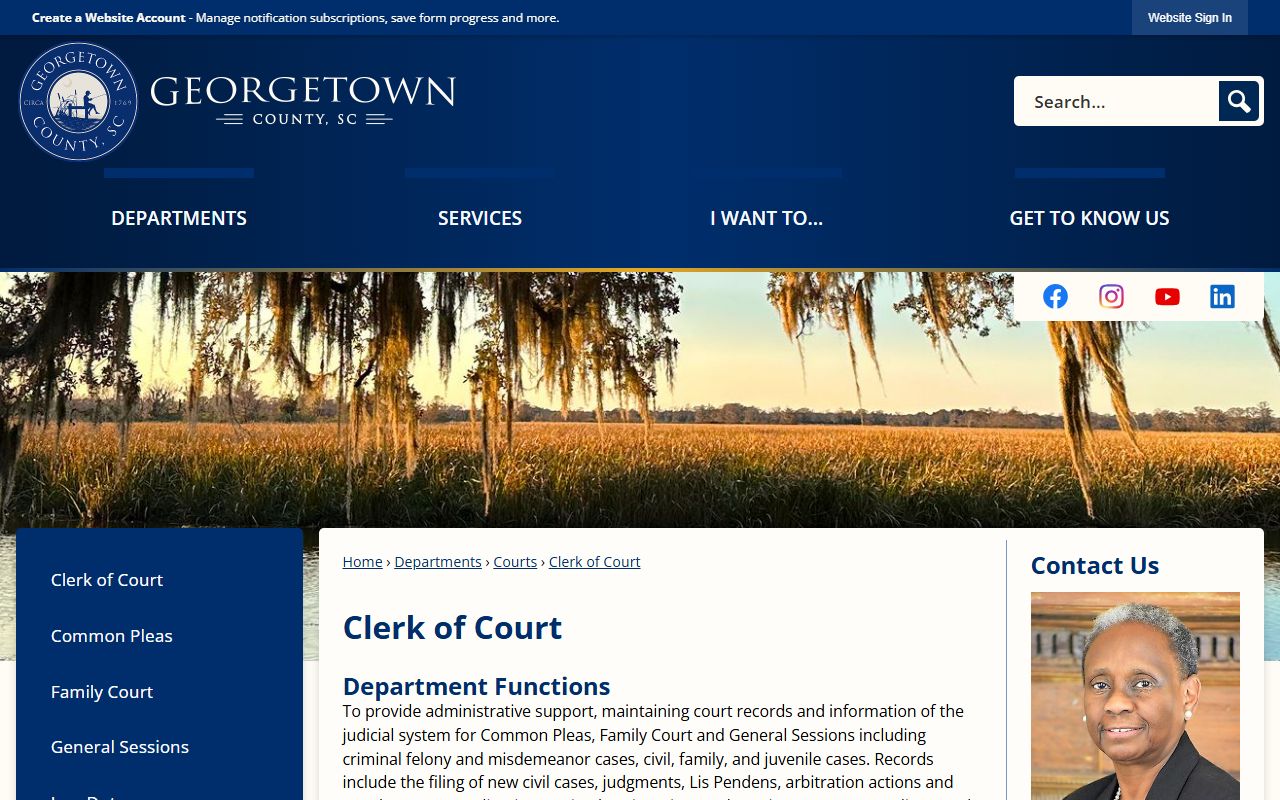
That office is the local court-record contact for Common Pleas, Family Court, General Sessions, court rosters, and criminal record administration.
Case Search Fields for Court Records After an Arrest
The South Carolina Judicial Branch case-records search is a statewide entry point, but Georgetown County case detail depends on the public index session and the court where the charge is filed. The research captured the entry-level fields and access limits rather than a single static Georgetown form.
| Field Label | Type | Required | Notes |
|---|---|---|---|
| County | County selection or link | Yes | Choose Georgetown County from the case records or public index path. |
| Search type | Tab, link, or form option | Unspecified | Public index searches commonly support party/name and case-number lookup. |
| Name | Text | Optional depending on search type | Use defendant or party name. Last name plus first name is usually cleaner than a broad search. |
| Case Number | Text | Optional depending on search type | Use the full court case number if it is known from a citation, bond paper, clerk notice, or attorney. |
| Date or range | Date filter | Optional where offered | Use filing or hearing ranges if the search page presents them. |
| Search or Submit | Button | Yes after fields | Runs the query. Browser cookies, JavaScript, and sometimes pop-ups must be allowed. |
How Charges Get Filed After an Arrest: Complaint, Information, and Indictment
Booking charges are arrest-intake labels. Formal court charges can be filed, amended, reduced, dismissed, indicted, or transferred as the case develops. In Georgetown County, bond court is listed at 2394 Browns Ferry Road, the same address as the detention center, while the courthouse and solicitor's Georgetown office are tied to 401 Cleland Street.
| Document | Who Usually Drives It | Common Use | Why It Matters |
|---|---|---|---|
| Warrant or complaint | Law enforcement and court process | Initial accusation, summary matters, or arrest support | Explains why the person was brought before the court. |
| Information or formal charge filing | Solicitor or prosecutor | Charges pursued after review | May differ from the wording on the jail card. |
| Indictment | Grand jury and solicitor process | Serious General Sessions prosecutions | Shows a formal felony-level prosecution path, not a conviction. |
| Citation or summary court filing | Officer, magistrate, or municipal process | Traffic, magistrate, municipal, and lower-level matters | May stay outside General Sessions unless the charge level changes. |
Charge Status in Georgetown County Court Records After Arrest
Charge status should be read one charge at a time. A single arrest can have multiple charges, and each charge can move differently. One count may be dismissed, another may be amended, and another may remain pending. The jail roster may still show the original booking wording even when the court record has moved forward.
| Status | What It Means |
|---|---|
| Pending | The charge has not reached a final disposition. Hearings, negotiation, indictment, plea, trial, or dismissal may still occur. |
| Amended | The charge wording, code, level, or count has changed by prosecutor or court action. |
| Reduced | The charge has been lowered in severity or replaced with a lesser offense. |
| Dismissed | The court or prosecutor ended that charge, subject to the details in the case file. |
| Nolle prosequi | The solicitor elected not to proceed on that charge at that stage. |
| Disposition | The current or final outcome recorded by the court for a specific charge. |
Bond and Release After an Arrest
Bond decides release conditions while the case continues. It does not erase a charge, prove guilt, or close a court record. Georgetown County Bond Court is listed at the detention center address, and the sheriff site includes a Bonding Court page and a List of Bondsmen page. South Carolina bail and recognizance rules are found in Title 17, Chapter 15. Verify bond amounts and holds with the jail or court because roster information can lag behind court orders.
| Bond Type | How It Works |
|---|---|
| Cash bond | The required amount is paid directly under court rules and later refund or disposition rules. |
| Surety bond | A licensed bondsman posts bond for a fee. Use the sheriff's official bondsmen list rather than unofficial ads. |
| Personal recognizance | Release based on a promise to appear, sometimes with conditions. |
| Property bond | Property may secure release when allowed by court order and applicable rules. |
| No-bond hold | The person remains in custody because bond is denied, not set, or blocked by another hold. |
Warrants That Lead to an Arrest
No dedicated official Georgetown County active-warrant search page was confirmed in the research. A warrant question should be routed through the sheriff, the issuing court, the court case search, or an attorney if the person may be wanted. The Georgetown County Sheriff's Office main phone is (843) 546-5102, and the detention center phone is (843) 545-3400 when the question is tied to custody.
Bench warrants, failure-to-appear events, magistrate matters, municipal matters, traffic cases, domestic violence matters, and family court issues may not appear in a sheriff web list. Once a warrant is served and the person is booked, the sheriff roster may show the booking, charge description, and bond amount.
Charges vs. Convictions
An arrest or charge is not the same as a conviction. Georgetown County court records after an arrest may show accusations that are pending, amended, dismissed, or resolved without a guilty finding. A conviction usually requires a guilty plea, verdict, or other adjudication recorded by the court.
| Charge | Conviction | |
|---|---|---|
| Stage | Accusation after arrest or filing | Final guilty outcome by plea, verdict, or adjudication |
| Proof level | May begin with probable cause or prosecutor filing | Requires the criminal-case standard and court acceptance or verdict |
| Can change? | Yes. It may be amended, reduced, dismissed, or not prosecuted. | Can be appealed, challenged, or affected by later court orders. |
| Use caution | Do not treat a booking charge as guilt. | Read the exact disposition and sentence fields. |
Sealed vs. Expunged Arrest Records
South Carolina public access is shaped by FOIA, court rules, juvenile confidentiality, and expungement law. Title 17, Chapter 1 includes arrest-record destruction and expungement-related provisions. A dismissal or eligible outcome does not automatically mean every public trace disappears the same day, and a public website removal process was not located in the Georgetown County research.
| Sealed | Expunged | |
|---|---|---|
| Public visibility | Hidden or restricted from ordinary public access by rule or order. | Removed or destroyed according to an expungement order and applicable statute. |
| Agency access | Some courts or law-enforcement agencies may retain limited access. | Access is more restricted, but the exact effect depends on the order and law. |
| Eligibility | Depends on record type, juvenile status, privacy rules, or court order. | Depends on South Carolina eligibility, disposition, waiting periods, and court process. |
| Practical step | Ask the clerk or an attorney which order applies. | Verify the expungement order with the court and originating agency. |
Background Check Considerations
Casual court lookup is different from a regulated background check. Court records, jail records, and public index entries can be incomplete, delayed, restricted, or outdated. Employers, landlords, insurers, lenders, and others using criminal-history information for regulated decisions must follow the Fair Credit Reporting Act and other applicable law.
Important: This site is not a consumer reporting agency and cannot be used for employment, credit, insurance, tenant screening, or any FCRA-covered decision.
Restricted Court Records After an Arrest in Georgetown County
South Carolina FOIA supports public access to records. Section 30-4-30 gives the public the right to inspect or copy public records unless an exemption applies, Section 30-4-40 allows exemptions that can affect law-enforcement and privacy-sensitive information, and Section 30-4-50 requires certain arrest and report information to be made public. Juvenile records, sealed cases, expunged matters, protected personal details, medical information, safety-sensitive jail data, and active investigative material can still be withheld or limited.
When a public search does not show a case, the reason may be timing, court level, spelling, a sealed or expunged record, a juvenile restriction, a transferred case, or a browser/session issue in the public index. Use the Clerk of Court, the issuing court, or the solicitor's office for the next step when a court record after a jail arrest cannot be confirmed online.